
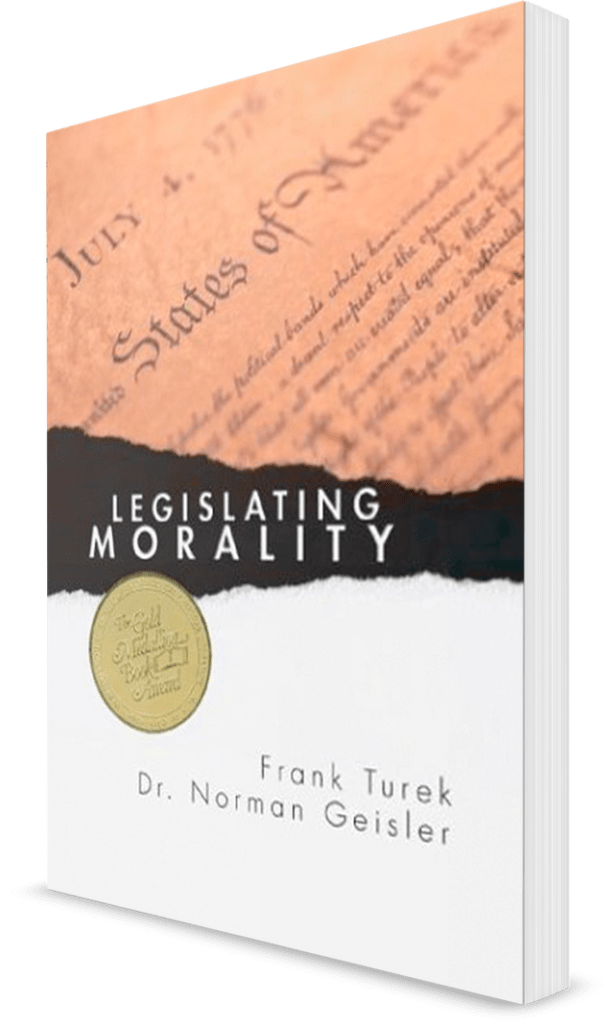
Legislating Morality is a book I have been dying to read for a long time. I was waiting to see if it would be released on Kindle. Unfortunately, it never was, so I decided to buy it. I’m so glad I did.
Although this book was released in 2003, it is like it was written last year. Many of the issues authors Norman Geisler and Frank Turek discuss apply very much to today’s society. In fact, some claims we hear regarding morality, such as, “As long as I don’t hurt anyone else, I’m free to do as I please”, are examined and discussed.
Even though some of the content of Legislating Morality is geared more towards an American audience, anyone can apply the principles taught in this book. You may even change your mind on some issues. Below are three reasons why this book will help equip you for conversations with loved ones and people you meet who share views different from yours.
1. Great Responses To Difficult Issues

Three chapters are dedicated to the most hot-button topics of our day: Homosexuality, abortion and euthanasia. They were by far the most challenging to get through.
In Chapter 9, Norman and Frank discuss homosexuality and the effects of living a same-sex-attracted lifestyle. Their research revealed several things that many do not consider when discussing homosexuality. One of them is life spans.
The authors discovered that the median age for a practising homosexual is about forty years old and that monogamous homosexual relationships shorten their lifespan even more than non-monogamous ones! Knowing this and other facts presented in this chapter will give you a bigger picture of the LGBTQ+ movement, some of the slogans they use to defend it and how to respond.
In Chapter 10, the authors give detailed facts about the unborn and challenge many pro-choice arguments. For instance, one fact they discuss is the genetic information of a newly fertilised egg. In addition, one of the pro-choice arguments they rebut is “Women must have the freedom to choose!” They do this by referring to a vice presidential debate between Al Gore and Dan Quayle, stating the following:
Freedom to choose what? After all, it is a scientific fact that an unborn child is a human being. So why do you insist that a mother has a right to choose the death of an innocent baby?… No one has a right to choose murder. In fact, no one has the moral right to choose anything that directly ends the life of another innocent human being. The right to life is the right to all other rights. Without life we’d all have no rights whatsoever.
Norman, G. & Turek, F. (2003) Legislating Morality, pp 159.
This chapter is filled with a number of examples like the above, which will come in handy when you find yourself in a discussion about abortion.
Chapter 11 on euthanasia was the most eye-opening but most challenging to read. The chapter opens with the “Baby Doe” case about a baby who was born with Down’s syndrome and had an obstruction in his oesophagus. It was a serious condition but was treatable. However, Dr. Owens decided not to treat the baby and convinced the parents to allow the baby to die, which is precisely what happened.
Norman and Frank explain extensively how abortion leads to infanticide and infanticide leads to euthanasia and why this should greatly concern us. Some may not agree with this at first, but once you have read the chapter, how they came to this conclusion will make more sense.
2. No Bible Verses Used

Usually, I would not recommend any Christian apologetics book that doesn’t use the Bible to argue their case, but this book is one of the exceptions.
Today, Christians run into people who are hostile towards the Bible or don’t believe it’s the Word of God. They use Christian terminologies or ‘Christianese’ to make their case, but often, the person they are talking to looks at them as if they were from another planet.
Christians engaging in apologetics help bridge that gap in their writings. They often write about cultural issues, objections to Christianity, or false claims. They use logic, reason, research, statistics, historical facts, and the Bible.
However, someone who doesn’t hold a Christian worldview or has no interest in Christianity will likely not read these kinds of books. That is what is unique about Legislating Morality.
This book does not use any Bible verses to make its claims about morality. Instead, they focus on using the Moral Law (also known as conscience) to make their case. What is good about the Moral Law is that it shares biblical principles but is not based on the Bible. The Moral Law is written in every person’s heart, no matter where they are from. Through it, people know right from wrong; that is, it is good to help the poor, and it is wrong to murder.
Throughout the book, Norman and Frank show the importance of the Moral Law by describing situations where it is and isn’t applied and its effect. For instance, they go into depth about the writing of the Declaration of Independence and how specific laws and practices were later abolished because the people in power used the Moral Law as its foundation.
Similarly, they discuss how, historically, when a nation removed God from its society and turned away from moral absolutes, bloodshed and all kinds of evil arose. For instance, World War II in Nazi Germany and all the atrocities that were committed.
This approach is very appropriate for today’s audience as it is a great example of how you can effectively communicate biblical principles without resorting to the Bible. Anyone who reads this book will be able to connect with the content and learn the importance of absolute morality.
3. This Book Gives Clear And Practical Examples That Are Easy To Find

Much of the book presents statements, for example, “We are consenting adults!”, explaining the point of view and refuting it. Sometimes, only the statement is given and is followed by a refutation, like in chapter nine.
For many, this kind of format is extremely helpful. Sometimes, when reading apologetic books, the reader can be overwhelmed by the information given. Although it can be precisely what the reader needs, it can be challenging to implement as the points made or advice given may be more theoretical than practical. Also, the person you’re speaking to may not give you the necessary time to give a page’s worth of an answer on a particular topic.
Legislating Morality provides you with primarily concrete answers; however, at times, there are some simple questions you can ask before responding to the claims made. Of course, you will need to adapt to the situations you encounter at times, but what is good is that you can be prepared and try to get the other person to think more about their position. Putting a stone in their shoe, as Greg likes to say.
If you liked this post, please subscribe to have my weekly blog posts delivered directly to your inbox.
Reference
Norman, G. & Turek, F. (2003) Legislating Morality
 showmethetruth.org
Leave a comment