My husband and I had a conversation about Christianity in Japan, and I asked him what kind of objections people generally have.
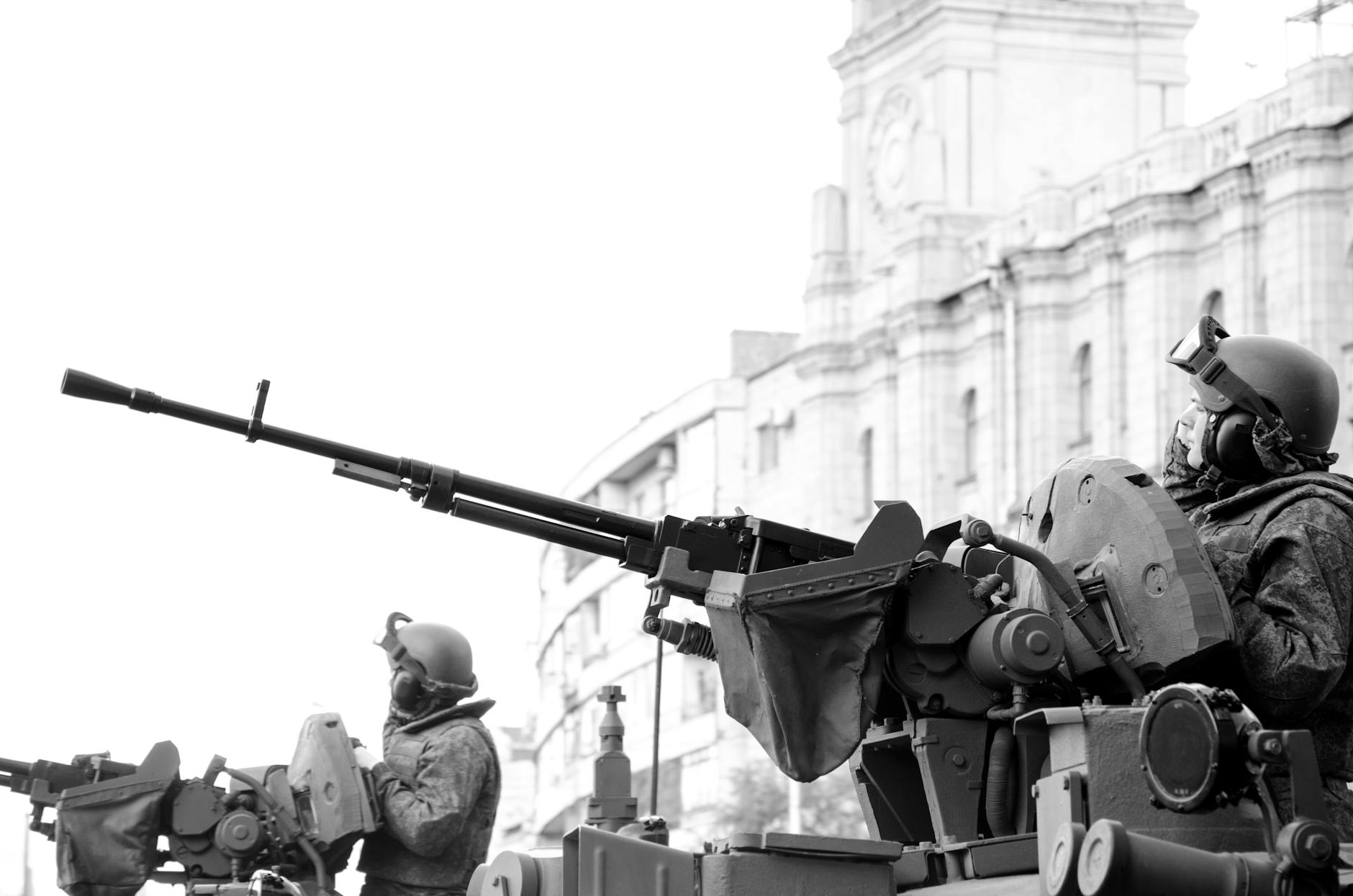
To my surprise, he said that some people are put off by Christianity because they believe that it is the reason wars start.
I was taken aback as historically the Japanese have shown great hostility towards Christianity and killed many Christians out of fear that they would overthrow the government.
My husband told me about some Catholics who shipped Japanese people to Europe as slaves and as a result, the Japanese government retaliated.
In this context, I understand why the Japanese reacted the way they did and why some still believe today that Christianity is to blame for war.
But is this really the case? Is it true that Christianity (or other religions) is the reason wars start? Let’s discuss.
Major Wars In History
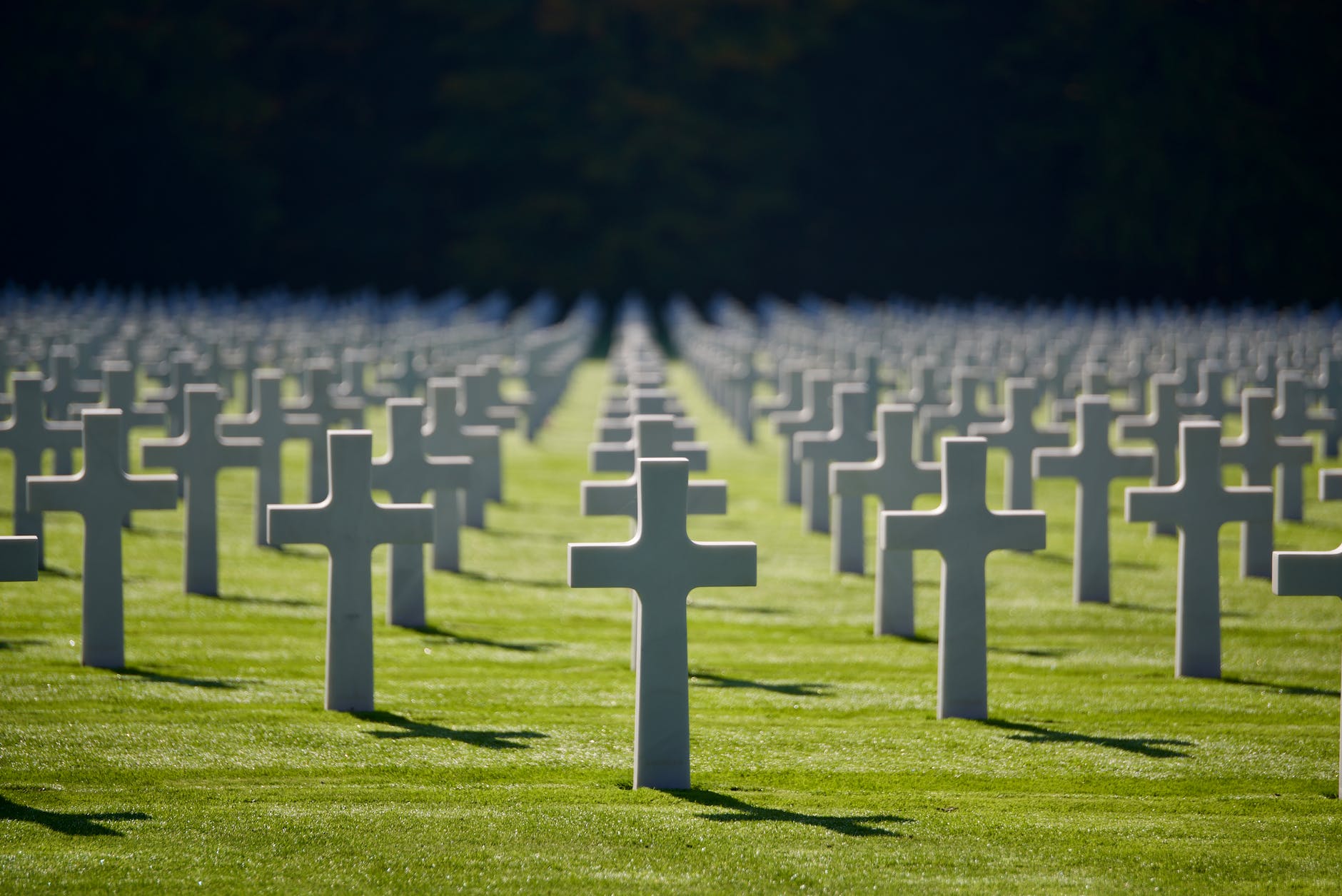
When I’ve heard people make such a claim in the past, I asked the person I was with to give an example. The only answer they really gave me was The Crusades.
The Crusades were a reaction to Muslims who were conquering Christian nations, subjugating people into converting to Islam and killing those who didn’t.
There were, unfortunately, some members of The Crusades who committed heinous acts, but they were, for the most part, the minority.
Despite knowing this, I thought it would be good to look more into the major wars in modern history and find out the reasons why they began.
I wanted to see if claims about Christianity or other religions starting wars had any credibility or if there were other factors involved.
Below are the wars, the death tolls, and the reasons they began.
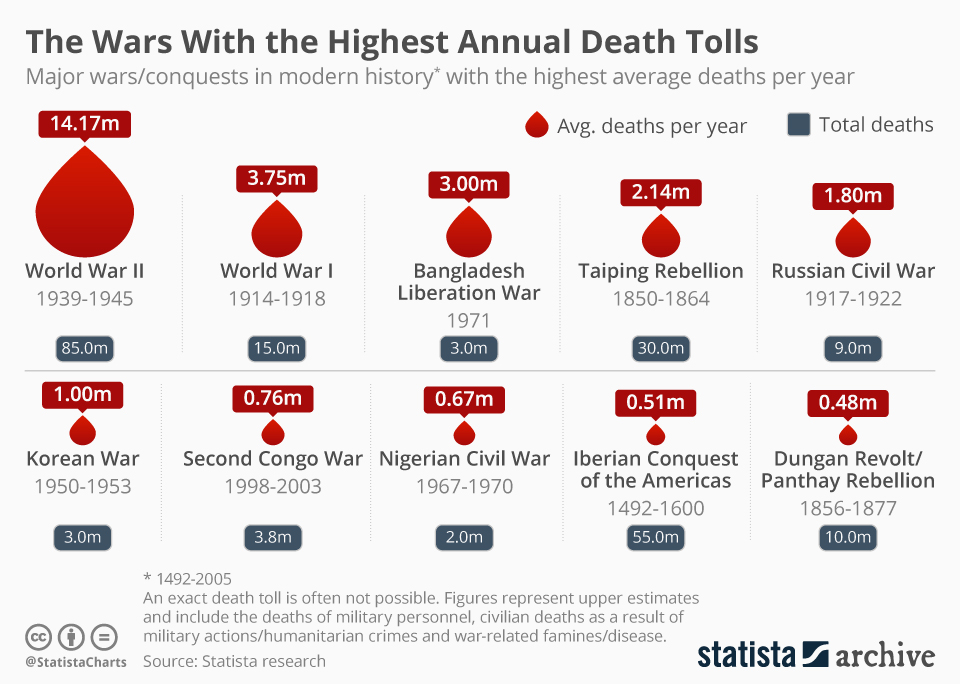
World War II: Political and Economic Instability in Germany
World War I: Assassination of Archduke Francis Fernidad
The Bangladesh Liberation War: Political crisis and oppression by Pakistan
The Taiping Rebellion: Animosity between Ethnic groups
The Russian Civil War: Opposition to Lenin
The Korean War: Communism vs capitalism
Second Congo War/Nigerian Civil War: Economic, Ethnic, Cultural and Religious
The Iberian Conquest: Oppression and infighting between tribes and conquerors
Panthay War: Race and Class Discrimination
As you can see, most of the wars listed did not take off because of Christianity or other religions.
The Iberian Conquest did have a religious element where the conquerors built churches and were aggressive in converting people to Catholicism. However, this was not a major part of the entire conquest.
The Nigerian Civil War had an element of conflict between ethnic and religious groups, but the political climate is what really caused the war to start.
Okay so now that this is a little bit clearer, what does this mean for Christianity’s role historically speaking? Has Christianity benefitted or harmed society as a whole?
Christianity And Society

For decades, Christianity has been heavily scrutinized by people from all walks of life. Its teachings and principles have been mocked and ridiculed. Many (even some who claim to be Christian) use Jesus Christ as a curse word or to show disgust.
Some politicians today are hostile towards Christians who believe in the Word of God and apply it to their lives. They are called ‘Christian Nationalists’ if they quote from the Bible or address God as ‘Father,’ like Pastor Jack was when he opened up Congress in prayer last month.
Do you think any of this is warranted? I don’t. This is because Christianity has done far more good for society than evil.
It is a faith that commands people to love their neighbour, no matter what they believe or how they live. To love your neighbour is to look out for the best interests of them and to tell them the truth.
Christianity has also brought in several things that we take for granted today: universities, art, music, places to meet, and science.
On top of that, some Christian leaders have impacted societies so much that they helped to end practices that were very harmful and caused several issues.
Education
Jesus followers took the command to make disciples very seriously. They needed to depend on the Book to do this and realized that they needed to help people learn how to read.
Ulfilas (311-c. 383 CE), for example, was a missionary who evangelized the Goths and invented an alphabet that would help him translate the Bible into the Gothic language so they could learn how to read.
Over time, more and more missionaries did the same and even today Christians are translating the Bible into other languages. This was the foundation for the building of institutions.
Christians met in communities of teachers and scholars early in history and over time they grew into institutions of learning where courses, examinations, and academic degrees were formed. Students spent two to three years learning in their instructor’s home.
Later the Christian communities expanded, formalized the curriculum and started schools. Eventually, universities were established.
The universities of Bolognia, Oxford, and Paris were inspired by Jesus and established by His followers.
A Place To Meet, Art and Music
Jesus followers had been meeting in places for centuries where they would sing hymns and admire the art around them.
The early Christians met in homes, and while they fellowshipped and worshipped the Lord, they were inspired to worship in a place where there was more room and light.
This led Christian builders and architects to build churches for centuries, developing their skills with each building they built and solving structural and lighting issues. These include the forming of domes and the flying buttress.
Similarly, Jesus followers created artwork out of their inspiration of Him. Painters and sculptors applied their skills to create the story of Jesus: His ministry, death, and resurrection. The Renaissance was an explosion of this.
Other nations, such as Japan, Ecuador, China, and South Africa, even have their own artwork that depicts Jesus in their image!
In addition to this, Christian composers dominate music history. They advanced music form and even added new instruments. Jesus followers influenced almost every genre of music we listen to today (jazz, rock, hip-hop, etc).
Science
Jesus appeared right before the growth of science began. After the Roman Empire ended the persecution of Christians and Christianity became the official religion, science began to increase.
Over time and with the establishment of Christian institutions, the printing press and the Protestant Reformation, science began to skyrocket.
Christian scientists were the majority because their worldview coincided with scientific discoveries and an understanding of how the world works (matter, universe design, observing nature to better understand God, etc).
Two Prominent Christians Who Significantly Changed Societies
Probably the most famous Christian politician of all time was William Wilberforce, who led the movement to abolish the slave trade in Britain. He battled for 40 years to see the end of slavery in Great Britain.
William Carey is known for his involvement in banning the practice of Sati in India. Sati involved a widow burning herself on her husband’s funeral pyre.
William saw this and fought for 25 years to have it banned. He also fought against institutions that promoted polygamy, female infanticide, child marriage euthanasia and illiteracy for females.
Final Thoughts
While the majority of wars are not caused by Christianity or other religions, there are things that some Christians do that don’t line up with the teachings of Scripture. There are some Christians who act poorly, do things that they really ought not to do and cause harm to others.
This does not mean that Christianity is false. This does not mean that Christian principles are not good for society. This does not mean that the Bible is not to trusted. It means that people are fallen and need the Saviour, Jesus Christ.
Who is your favourite Christian leader who has made an impact on society? Let me know in the comments!
If you enjoyed this post, like and subscribe so you can stay up-to-date with my weekly posts.
 showmethetruth.org
Leave a comment